The Narrow Path

The picture below is from a part of the PATH near my house that I pass by frequently.  Wouldn’t it be nice if we had signs and guard rails like this in every area of our life?  Today we’ll talk about the narrow road that Jesus wants us to follow in life and how we can install some signs & guardrails like the ones in this picture.
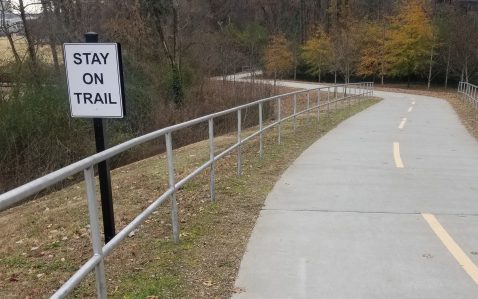
Matthew 7:13-14 says “Enter through the narrow gate.  For wide is the gate and broad the road that leads to destruction, and many enter through it.  But small is the gate and narrow the road that leads to life….”.

In speaking these words, Jesus is encouraging us to follow Him and His commands.  And, as we’ve discussed many times, at the very root of all of His teachings is the idea that we are always supposed to Love God and Love people.

There is nothing complicated about the narrow road.  It is extremely simple and does not require a lot of advanced thinking to understand.  For example, here are a few things we can do to stay on the narrow road: be nice, eat & drink in moderation, be patient and kind, be happy with what you have and thankful for it, don’t brag (not even humble-bragging), don’t be rude or self-serving, be quick to forgive others and yourself.

Although none of these concepts are complicated, every one of us strays from the path from time to time and all of us can benefit from guardrails and signs that remind us to stay on the narrow road.  So here are a few simple ideas that may help:

  • Study the narrow road – Read the Bible and other wisdom literature daily. Listen to wisdom-oriented podcasts.  Attend church, Bible studies, and small groups.
  • Plan in advance for stormy waters – If you know you are going into a situation that will challenge your ability to stay on the narrow road, think about it in advance and have a plan.
  • Develop a recovery protocol – When you stray from the narrow path, have a pre-determined plan to get back on track as quickly as possible.
  • Accountability – Seek out an accountability partner in whom you can confide and be real. Sharing your struggles with another person is a very effective way of expediting the process of getting back on track.

The Advent season is a great time of year to reflect on narrowing your path in the coming year.  Your efforts to move your guardrails in a little (or a lot) will bless not just you but your family and everyone around you.  Here are a few questions for discussion:

  • Jesus says that the “wide gate and broad road leads to destruction”. What do you think He means by “destruction”?
  • Do you have any examples of narrowing your path and installing guardrails in your life that had positive results?
  • If there is truly nothing complicated about the “narrow road” why is it so difficult to stay on it?
  • What is one area of your life where you would like to install guardrails and narrow your road in the coming year?
  • For you personally, what strategy do you think would be most effective to help you stay on the narrow path in the coming year? It could be one of the four ideas listed above or something else.
The Discipleship Conveyor Belt

Rev. Jeff Rogers delivered the sermon at Northside last Sunday and painted a beautiful picture of the mentoring relationship Paul had with Timothy.  As Paul got older and became less physically active, he knew that there needed to be a capable leader to step into his shoes and continue spreading the ministry.  Paul picked Timothy for this honor and spent significant time mentoring him so he could take over.  That brings us to today’s verse which is from Proverbs 27:17:

“Iron sharpens iron, and one man sharpens another”

Rev. Jeff had a few points about mentoring others:

  • If you are mentoring someone, you need to pray for them. Paul said that he prayed constantly for Timothy.
  • You should truly care about those you are mentoring and want the best for them. You should give them guidance that will in-turn help them become better disciples for Jesus.
  • You should “pour yourself” in to those you are mentoring, meaning that you should invest in them in order to create a return on that investment.

One of his points was that we may not feel ready to mentor another person because we don’t feel equipped or qualified to do so.  If that describes you, then you should reach out to Christian men you trust and respect in order to help bring you along on the road to discipleship.

This might feel like a heavy burden for those of us who really just want to go to church or a Bible study in order to be fed but who don’t really have an interest in taking on more responsibility than that.  The idea that God expects us to be a disciple to others and not just someone who sits and listens might be a lot to process.

But it may help to think about the church as a disciple factory.  The goal is to be constantly moving people along a discipleship conveyor belt.  What would be the point of it all otherwise?  Imagine a car factory that didn’t produce cars….it wouldn’t stay in business very long because the whole purpose of the factory is to produce a finished car that someone will buy.

But unlike a car factory, we don’t have to become a “completed” or “perfect” disciple before we engage in mentoring others and bringing them along.  There will always be someone ahead of you and behind you on the discipleship conveyor belt.  For those behind you, there is an opportunity to reach back and offer them a hand forward.  And, in the same way, we need to reach out to those ahead of us in order to accelerate our discipleship growth.

Here are a few questions for discussion:

  • Do you agree with the idea that God expects all of us to be moving along a discipleship “conveyor belt”?
  • Does mentoring others in their Christian walk necessarily need to be a formal process or can it be more informal?
  • Are you comfortable with the idea that you should always be working on becoming a better disciple in order to mentor others in your life and help them become better disciples?
  • What are some simple things we can do to be a mentor to others even if those efforts aren’t through a formal mentoring program?
  • In what ways can each of us better prepare ourselves to be a disciple who can be used by God?

Getting Our Minds Right for the Holidays

As we start November, our minds will soon turn to the holiday season and all the busyness and activities.  Today’s lesson will challenge us to think about the holidays differently this year – to slow down and be present in order to honor God.  Today’s Bible passage from Luke 10:38-40 reminds us to focus on the important things in life.

As Jesus and his disciples were on their way, he came to a village where a woman named Martha opened her home to him.  She had a sister called Mary, who sat at the Lord’s feet listening to what he said.  But Martha was distracted by all the preparations that had to be made. She came to him and asked, “Lord, don’t you care that my sister has left me to do the work by myself? Tell her to help me!”

“Martha, Martha,” the Lord answered, “you are worried and upset about many things, but few things are needed—or indeed only one. Mary has chosen what is better, and it will not be taken away from her.”

So Jesus unexpectedly shows up at Martha’s house and she starts running around the cleaning up the place and getting some snacks together while Mary stops to soak in as much of Jesus as she could.  Martha complains that Mary is helping but Jesus encourages her to stop worrying about so many things and just focus on the one thing – Him.

Although Jesus is with us in Spirit all the time, he isn’t dropping by any of our houses for a visit so what are we supposed to take away from this story?  I believe if Jesus were here he would give us two things to do this holiday season – turn our minds toward God more frequently and be fully present with our family & friends.

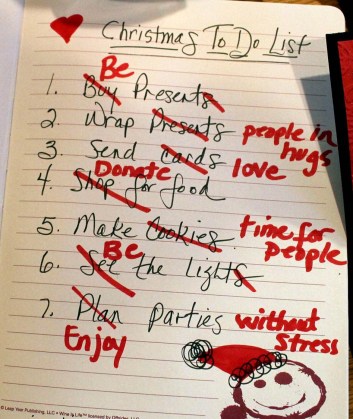
Jesus ends by saying that we should focus on the things that can’t be taken away from us.  For example, a clean house gets messy again but the value of quality time with loved ones can’t be taken away.  People will not remember you picked the perfect wine pairings for your party but they will remember if you were fully present in conversation with them.  People won’t remember the cookies your family made to give as gifts as much as they will remember the time you spent with them when you dropped them off.

We’ll wrap up with the picture below which sums up today’s lesson well:

Questions:

  1. During the holiday season, do you typically feel more like Mary (focused on the right things) or like Martha (focused on the busyness of getting it all in)?
  2. If you had a chance to ask Jesus how to be more like Mary than Martha, what do you think he would suggest?
  3. Even though  today’s lesson is very simple, we often get sidetracked.  What are some of the main reasons we lose our way sometimes and act like Martha?
  4. Some would say that one of the keys to today’s lesson is to say “no” to certain things in order to say “yes” to more of the important things.  What are some things you might need to say “no” to this holiday season?
  5. Based on today’s lesson, what are some things you would like to do differently this holiday season?

Ego is the Enemy

Ego is a topic that came up the last two weeks in our group conversations.  Two weeks ago, it was in relation to the parable of the sower.  Our worries about life and the deceitfulness of wealth are like weeds that choke out the message God wants us to hear.  And last week it was in relation to keeping our eyes on Jesus so we don’t sink like Peter started to do before Jesus saved him.  Worries and an intense focus on striving for wealth can distract us from the message of Jesus.  So today we’ll dig in a little deeper and discuss how we can suppress our ego in order to remove barriers between us and God.

For the purpose of this discussion, when we say “ego” we are referring to an over-inflated sense of our own self-importance.  That is different than feeling good about ourselves which God wants us to do.  He wants us to be at peace and rest easy knowing that all our needs will be provided and that He has a plan to prosper us (Jeremiah 29:11).  But when we forget that and try to put ourselves in God’s place, taking the wheel from Him, we get in trouble.

That brings us to today’s verse which is from Proverbs 16:18

Pride goes before destruction, a haughty spirit before a fall.

Ego (or pride) is something that people have struggled with forever, but I believe it may be a more difficult challenge today than it has ever been – and it is getting worse.  Just looking at Facebook or Instagram (or any social media) for even a few minutes has been proven to make us feel worse, primarily because people post their best experiences which can make us want to match or exceed them.  Additionally, advertisers have access to your search histories which is why you keep getting bombarded with ads for things you really want – and things that take more money to get.

Certainly there are many contributors to an inflated ego but I believe these two things (social media and advertising) are two of the most powerful forces that create a desire in us to make something good happen right now instead of patiently waiting for the blessings God has in store for us.  This then drives us to want to take the wheel from God so that we fast-track the good things we think we deserve.  That, in turn, drives us to want to make more money and, unfortunately, in some cases take shortcuts.

Suppressing the ego and managing pride is like running a marathon – it is a long, slow process that takes a lot of work.  Hopefully, today’s lesson will at least help us recognize some of the core problems and take steps in the right direction.

Questions

  • Why do you think the topic of ego keeps coming up in our group discussions?
  • Do you agree that social media and advertising are major contributors to an over-inflated ego?  Why or why not?
  • Today’s verse says: Pride goes before destruction, a haughty spirit before a fall. Why do you think pride or ego can cause destruction or a fall?
  • How would you explain the idea that God wants us to suppress our ego but also wants us to feel great about ourselves?
  • What are some habits or practices you can form or break that might help suppress ego?

Keep Your Eyes on Jesus

After preaching to a large crowd one day, Jesus sent his disciples across to the other side of the lake and told them to wait for him there.   We get the rest of the story from Matthew 14:25-31 which says:

25 Shortly before dawn Jesus went out to them, walking on the lake.26 When the disciples saw him walking on the lake, they were terrified. “It’s a ghost,” they said, and cried out in fear. 27 But Jesus immediately said to them: “Take courage! It is I. Don’t be afraid.” 28 “Lord, if it’s you,” Peter replied, “tell me to come to you on the water.” 29 “Come,” he said.  Then Peter got down out of the boat, walked on the water and came toward Jesus. 30 But when he saw the wind, he was afraid and, beginning to sink, cried out, “Lord, save me!” 31 Immediately Jesus reached out his hand and caught him. “You of little faith,” he said, “why did you doubt?”

It is tempting to judge Peter for doubting that Jesus was going to protect him but then I remember that I’m probably even worse!  One of the things that stuck out to me in this passage is that Peter knew that Jesus could miraculously help him walk on water.  So what was Peter’s downfall?  It was when he took his eyes off of Jesus.  Verse 30 says “when he saw the wind he was afraid”.

When Peter allowed his focus to switch from Jesus to the wind he became scared and started to sink.  But when he returned his focus to Jesus and cried out to Him, Jesus reached out His hand to save Peter.

So then we need to ask why God would design us in such a way that we start sinking if we take our eyes off of Him.  Here are a few possibilities:

  1. God wants us to take risks and get outside of our comfort zone so that we are always growing, but this means we are going to see some storms from time to time.
  2. We cannot save ourselves but that doesn’t keep us from trying!  God wants us to be reminded how much we need Him.
  3. Sinking can help prepare us to help rescue others. In Luke 22:32, Jesus told Peter “I have prayed for you, that your faith should not fail; and when you have returned to Me, strengthen your brethren”.  Jesus allowed Peter to fail and, by overcoming that negative experience, he emerged stronger in his faith. Afterward, he was able to relate to others with more compassion and help them overcome by God’s grace.

As a final thought, a wise person once said that God will let you sink so low that you know you can’t live without Him and He will take you so high that you’ll know you you couldn’t have gotten there without Him.

Questions:

  1. Can you relate to Peter?  Do you ever feel like you are sinking because you take your eyes off of Jesus?
  2. Do you have any stories about returning your eyes to Jesus and being saved?
  3. Do you agree that God wants us to sink a little (or a lot) from time to time?  If so, why?
  4. Are you struggling with anything right now that is taking your eyes off of Jesus?  If you are comfortable, please share with the group.
  5. Based on today’s lesson, what is something you might change to try to do a better job of keeping your eyes on Jesus?

Parable of the Sower

Today’s lesson is from Matthew 13 and has more scripture than usual because it includes most of Jesus’ parable of the sower. Jesus frequently spoke in parables that were relatable to his audience.  In today’s lesson, he uses a farming reference because this is something everyone understood. Matthew 13:2 tells us that the crowds had grown so large that day that Jesus had get in a boat and preach from just off the beach.

Matthew 13:1-9 says: That same day Jesus went out of the house and sat by the lake. Such large crowds gathered around him that he got into a boat and sat in it, while all the people stood on the shore. Then he told them many things in parables, saying: “A farmer went out to sow his seed. As he was scattering the seed, some fell along the path, and the birds came and ate it up. Some fell on rocky places, where it did not have much soil. It sprang up quickly, because the soil was shallow. But when the sun came up, the plants were scorched, and they withered because they had no root. Other seed fell among thorns, which grew up and choked the plants. Still other seed fell on good soil, where it produced a crop—a hundred, sixty or thirty times what was sown. Whoever has ears, let them hear.”

Then Jesus provides an explanation in verses 18-23.  “Listen then to what the parable of the sower means: 19 When anyone hears the message about the kingdom and does not understand it, the evil one comes and snatches away what was sown in their heart. This is the seed sown along the path. 20 The seed falling on rocky ground refers to someone who hears the word and at once receives it with joy. 21 But since they have no root, they last only a short time. When trouble or persecution comes because of the word, they quickly fall away. 22 The seed falling among the thorns refers to someone who hears the word, but the worries of this life and the deceitfulness of wealth choke the word, making it unfruitful. 23 But the seed falling on good soil refers to someone who hears the word and understands it. This is the one who produces a crop, yielding a hundred, sixty or thirty times what was sown.”

Some of you may feel a relation to one of the three situations that prevent seeds from growing in our hearts and bearing fruit.  For me, it is probably the third one – worries of this life and deceitfulness of wealth.  If you are struggling with one of these situations, Jesus wants you to know that He understands that you are struggling and that He is with you in your efforts to grow good soil in your heart.  He wants all of us to bear much fruit which requires two basic elements: 1) hear the word and 2) have the word fall on good soil.  Below are a few questions to help us think through it more deeply.

Questions:

  • What do you think Jesus’ main goal was in preaching this message?
  • This passage tells us that only seeds that fall on good soil can grow to bear fruit. How would you describe “good soil” and how do we grow more of that in our hearts?
  • In your life, how much of God’s word falls on the good soil? And how much falls on the path, the rocky places, or among the thorns?
  • What is one thing you might do differently after today’s lesson to try to grow better soil so that you can bear more fruit?


The Double-Positive of Doing Good

We are starting a men’s mentoring program at Northside called Radical Mentoring.  It is a program designed to take men through a deep spiritual journey and help them move toward becoming better disciples.  At a recent meeting for leaders of this ministry, one of the major needs for the ministry was discussed and that is that middle-aged men are facing many new challenges that are causing significant additional stress in their lives. This stress is causing negative trends in mortality statistics, primarily due to suicide but also heart-related and other health issues.  So today we are going to flip this stress on its head and look at it from the other direction.  More specifically, we’re going to discuss how giving to and serving others has a double-positive effect – you are fulfilling your calling to do so and you are also helping yourself.

We’ll start with today’s verse which is from 2 Corinthians 9:7 and says:

“Each one must give as he has decided in his heart, not reluctantly or under compulsion, for God loves a cheerful giver.”

This verse is referring specifically to giving money and material items to the poor.  But for today’s lesson we are going to expand that concept to include every way you can give of yourself.  In addition to financial giving, this could also include spending time with people in need, sending a note to let someone know you are thinking about them, or doing a favor for someone without expecting reciprocation.

While these acts will not take away the cause of underlying stress in our own lives, it will redirect our minds and give us a different perspective.  And God will bless our giving if our actions are consistent with the verse above – we must be cheerful givers in order to get the biggest blessing.

So what’s the best form of service?  That depends on how God has equipped you and where He is calling you to serve.  When you pray next, ask God to put people in your path that need your help and to help you identify the areas where He most wants you to serve.  He will honor your prayer and give you answers about where to serve as well as how to reduce your own anxiety and stress.

Questions:

  • What are some of the biggest causes of stress in your life?
  • Do you agree that giving to others can have the double-positive impact of helping them and helping to relieve your own stress?
  • Do you have any examples of serving others that gave you an improved perspective or outlook?
  • What are some ways you think God may be calling you to serve others? That could include things you are already doing or things you feel like He may be calling you to do?

A New Creation in Christ

I’m writing this from Kiawah Island where our family spends a week each summer.  At least once each year, I bike about six miles on the beach to the far northern end of the island and this year that ride inspired today’s message.

The picture below shows what it looks like on that part of the island.  The picture shows two breaks in the beach where you can cross at low tide to get to a completely uninhabited portion of the island.

When we first visited the island, there was only one break in the beach – the one to the right in the picture – but then, over time, the one to left washed through and created the marshy area between the ocean and the golf course in the picture.  This change created a new habitat for fish, birds, and other wildlife.

When I rode by this area this year, it reminded me how our lives change over time and how those changes can lead to growth and make us, in a way, a new creation.

That brings us to today’s verse which is from 2 Corinthians 5:17 which says:

“Therefore, if anyone is in Christ, he is a new creation. The old has passed away; behold, the new has come.”

This island is a new creation after additional marsh is created and, in the same way, we are new creations in Christ once we allow Him to become our personal Lord and Savior.  And just as we can behold all of the new wildlife in the marsh, we are commanded in this verse to behold the new creation of anyone who is in Christ.

When we commit our lives to Christ, we are literally transformed into something new and this transformation makes us more useful to God.  Here are some examples:

  • We become more patient with our children
  • We see marriage as liberating instead of restrictive
  • A business failure can be seen as a beginning instead of an end
  • We see others through God’s eyes and understand how He wants us to love them
  • Material things start losing their grip on us and we start changing our financial priorities.

These are all examples of new “marshes” in our lives that result from allowing Jesus to enter in and create them.

Questions:

  • Do you have any personal “marsh” stories you can share with the group (something that happened in your life that allowed you to grow and become more useful to God)?
  • When opportunities for growth come along, we don’t always embrace them.  Why do we sometimes prefer to maintain the status quo even though growth will help us and others?
  • Is the process of becoming more useful to God typically an all-at-once thing or does it take a long time?
  • Do you currently have anything that you feel God is calling you to change so that you can be more useful to Him?


The Cure to FOMO

As much as I hate to say it, you and I cannot have it all.  My guess is that the maximum number of things we can simultaneous do is probably around four.  For example, you can have a good career, be a good family guy, exercise regularly, and be a good community supporter if you spend most of your time on those four things.  If you are really good, you might be able to fit in one more – maybe an 8 handicap, or extensive personal travel, or endurance sports, or lots of fishing & hunting.

But even if you are good enough to squeeze in five things, you may still feel inadequate because your friends’ social media posts show them collectively doing ALL of these things and lots more.  You might ask “why can’t I do my four things AND take pictures skydiving in Dubai AND playing at Pebble Beach AND with a 180 pound tarpon?”.

In short, we all have FOMO (fear of missing out) and we are less satisfied with our boring four or five things than ever.  And if we try to make it seven or eight things, it just makes everything worse.  But, fear not, the Bible has the answer we need to combat our FOMO and help us regain a sense of peace.

Our verse for today is from Philippians 3:13:

Friends, don’t get me wrong: by no means do I count myself an expert in all of this but I’ve got my eye on the goal, where God is beckoning us onward – to Jesus.

The author, Paul, was saying that even though he was throwing a lot at them at once, that they shouldn’t be anxious because not even he had it all mastered.  In a way, they may have been dealing with some FOMO of their own by thinking that they needed to master everything he was sharing with them.  But notice the real focus of Paul’s instruction which is to keep your eye on the goal of moving closer to Jesus.  In a world with an ever-increasing number of distractions, that is good advice for us too!

Questions:

  1. How many things would you currently say that you’re giving significant attention to?
  2. Of the things in question #1, how many are you doing well?
  3. Do you sometimes have FOMO?
  4. How can keeping our eyes on Jesus help us when we face the anxiety caused by trying to have it all?
  5. Have you thought of anything today that you might want to do less of so that you can focus on your top three or four things?  If so, please share if you feel comfortable.


How To Pray – Part 2

Last week we discussed the idea that God’s primary desire is to be in relationship with us and that He wants us to pray to Him.  We also talked about several roadblocks that keep us from praying more often.  Today we’ll we’ll go a little deeper into prayer and we’ll start with a passage from Matthew 6:9-10:

Our Father in heaven, hallowed be your name.  Your kingdom come, your will be done, on earth as it is in heaven.

These verses are the first two of the Lord’s prayer and, as you can see, they are  focused on God, not us.  Some of us have prayed the Lord’s prayer hundreds or even thousands of times but how often do we stop to think about what these two verses mean and why Jesus wants us to start with them?

I believe Jesus placed these verses first to tell us that God wants us to lift Him up above everything else and, that in order to in harmony with God, we need to recognize Him as our Father who created us & the world we live in and that His will is supreme.

But how do we typically view prayer?  It seems like most of the time we think about praying FOR something – career success, relief from pain & sickness, or maybe to do well on a test.  This view of prayer is consistent with two of the roadblocks to prayer we discussed last week:

  1. We don’t want to “bother” God with petty requests, and
  2. We don’t want to seem selfish by asking for things for ourselves

So if these things keep us from praying, maybe we should flip our thinking 180 degrees and look at prayer mostly as our chance to glorify God and tell Him how great we think He is?  Obviously, God already knows how great He is and doesn’t need us to tell Him.  So maybe He wants us to do this so we don’t forget.  When we look at it that way, prayer can viewed as something we need to do instead of something that’s optional.  Here are some questions for discussion:

  1. Do you agree with the idea that we mostly think of prayer as an opportunity to ask God for things?
  2. If we prioritize glorifying God in our prayers and pray more consistently, what are some of the good things that might come from doing that?
  3. When you think about prayer as primarily focused on glorifying God, does that make you want to pray more often?
  4. If you were teaching someone about prayer who had never heard of it, how would you describe its purpose?