Spiritual Gifts

Last week we discussed the idea of avoiding comparing ourselves to others, primarily because God created each of us for a very unique and special purpose. There were some exceptions (for example, it’s ok to mimic the actions of a worthy and wise role model) but, generally, it’s best to focus on God’s unique plan for your life. During this discussion, we touched on spiritual gifts and the role they play in helping us stay on the distinct path God has planned for each of us.

But what exactly are these spiritual gifts and how do we know which gifts we have? Let’s start with three references from scripture about spiritual gifts:

There are different kinds of gifts but the same Spirit. There are different kinds of service, but the same Lord. (1 Cor. 12:4-5)
 
Each one should use whatever gift they have received to serve others, faithfully administering God’s grace in its various forms. (1 Pet. 4:10)
 
Just as each of us has one body with many members, and these members do not all have the same function, so in Christ we who are many form one body, and each member belongs to all the others. We have different gifts, according to the grace given us. (Romans 12:4-6a)

For each of us, our unique path has unique challenges and opportunities to serve God. And He has already provided us with special gifts (spiritual gifts) to make us more effective along the way. As we use our spiritual gifts to serve God, we collectively strengthen the Body of Christ.

Here is a helpful link to an explanation of spiritual gifts that includes a list of all the gifts listed in various passages in the Bible.  These include administration, apostle, discernment, evangelism, exhortation, faith, giving, healings, helper, knowledge, leadership, mercy, miracles, pastor, prophesy, service, teaching, tongues (interpreting), and wisdom.

As examples, if your gifts are “missions” and “administration” then you may be best suited for various types of missions.  Or if your gifts are “teaching” and “leading” then you’ll be most effective in developing and leading teaching ministries.

There are hundreds of surveys online to help you determine your spiritual gifts.  Here is a good one created by the Methodist Church. Once you know your gifts, you’ll be better equipped to serve God and be more effective on your unique spiritual journey.

Questions:

  • Based on today’s lesson, why do you think it is important to understand your spiritual gifts?
  • Have you ever taken a spiritual gifts survey? If so, what are your gifts?
  • Whether or not you know your spiritual gifts, do you feel like you’ve been consistently attracted to certain types of service or ministries? If so, what specific gifts would that indicate you might have?
  • Is it a bad thing to volunteer or serve in ways that are not directly related to your spiritual gifts?

Comparison

Last week, we talked about the idea of replacing our “thorns” of fear, anxiety, and worry with a stronger faith and trust in God. When we are fearful and anxious, we are saying to God that we do not trust Him and that we place no faith in His promises.

One of the biggest drivers of fear and anxiety is the sin of comparison, and that is the subject of our verse for the day, which is from 2 Corinthians 10:12:

When they measure themselves by themselves and compare themselves with themselves, they are not wise.

In this verse, Paul is saying to the Corinthians that it is unwise to compare ourselves to others. If they had Instagram at that time, Paul might have added something like, “You should delete Insta and all other social media accounts, so your attention is not drawn away from the truth of Jesus Christ.”

So, why is comparison so dangerous and harmful? I believe it all boils down to the fact that God created us for a unique purpose and when we compare ourselves to others, it draws our attention away from that purpose. When we start comparing houses, cars, vacations, wardrobes, athletic ability, academic ability, and others, we can never truly be satisfied. Trying to keep up with others will be our constant distraction. There is no finish line to this race and the only one who is happy when we compare ourselves to others is the devil. He’s loves it when our eyes and hearts are distracted from God.

While most comparison is not wise, I think the following three types of comparison are good:

  1. Where are you in comparison to God’s plan for your life? Do you know our spiritual gifts and are you using them (Romans 12:6-8)? Are you focused primarily on loving God and loving others (Matthew 22:37-40)?
  2. Where are you today in comparison to where you were on your faith journey yesterday? Are you making progress? Do you have a plan for improvement?
  3. If you find someone who is a good role model, it is ok to compare yourself in limited ways as you try to mimic some of their positive attributes.

Otherwise, it’s best to keep our eyes on the prize and off of our neighbor’s stuff.

Questions:

  1. Do you agree that comparing ourselves to others creates anxiety and distracts us from God’s plan? Why or why not?
  2. In your experience, what are some of the main things people tend to compare?
  3. If social media is such a big source of comparison, is it possible to continue using social media without falling into the comparison trap? If so, what strategies might work for avoiding this trap?
  4. What benefits would you experience by limiting your comparison to other people this week?

Support – Part 1

I noticed this picture in the prayer chapel and it inspired a thought –

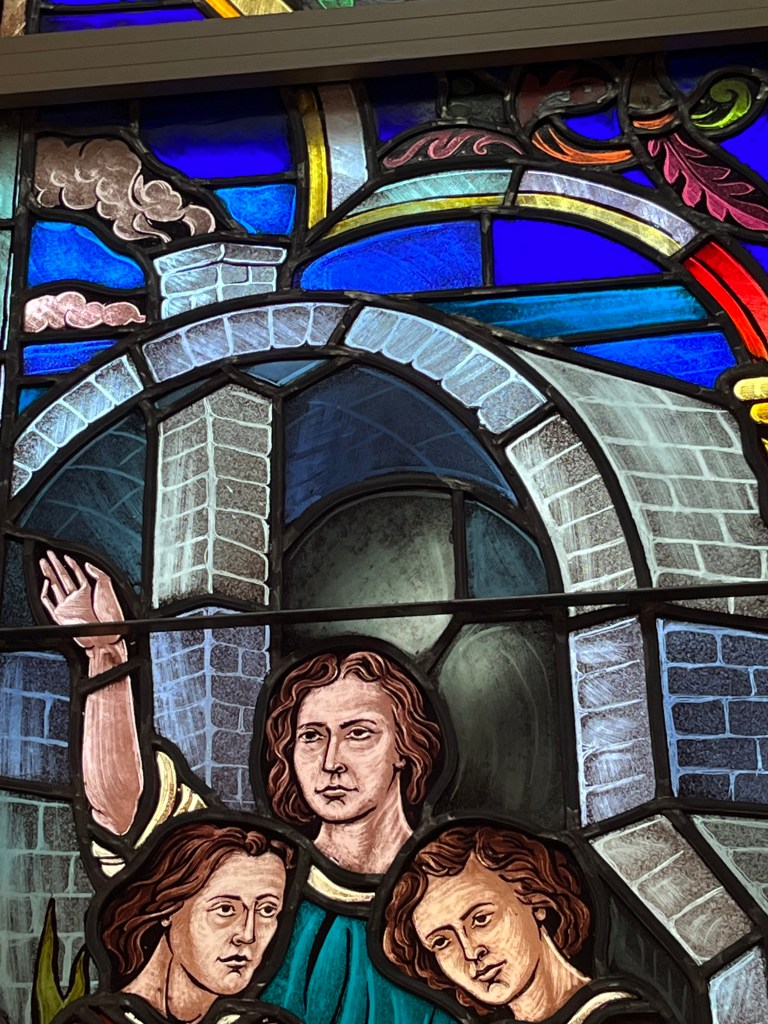
Here is a closer image:

An arch (as shown in the firepit above) is a very strong structure as long as each brick is in place and supporting its portion of the load. But if you remove just one brick, the arch will fall. That brings us to our verse for the day which is from 1 Thessalonians 5:11:

“So, continue encouraging each other and building each other up.”

If we compare our lives to an arch, we can start to think about the critical bricks that hold things together for us. These might include:

  • Relationship with God
  • Relationships with others
  • Healthy nutrition
  • Exercise
  • Quality sleep
  • Meaningful work
  • Stress management

We can probably think of many other examples, but for today we’ll focus on our relationship with others.

Our “arch” is strongest when we are supported by the following individuals, in order of importance:

  • Immediate family
  • Extended family and closest friends
  • Other friends and acquaintances

Although we know our arch is strongest when we maintain quality relationships with those closest to us, sometimes it’s easiest to ignore these individuals or even hurt them. So, as a starting point, we can think through the needs of our closest relationships and focus our energies there. What are their love languages? Where can we provide the most support and encouragement? As these relationships are strengthened, our arch is strengthened.

And maybe you have a weak or missing brick in your arch that really needs a lot of work. If so, like every other difficult challenge, there is one proven way to start thinking about the solution – go to God in prayer and ask Him for miraculous healing. And as you ask Him for guidance, focus only on the ideal scenario and don’t slip back into old ways of thinking. These old ruts are the devil’s way of trying to pull you back because he hates it when strained relationships are healed. If you are giving it to God, really give it to God and focus only on the perfect solution you know he can create.

As you start this exercise, a good first step is to think through the prioritized list above and review each relationship. Which ones are strong? Which ones need work? Which ones need a miracle? And sometimes, when we think about strengthening our own arch, the first thing we really need to do is consider how we can help strengthen others’ arches first.

Here are a few questions to help us think more about today’s topic –

Questions:

  1. Do you agree that our arch is strongest when we maintain the high-quality relationships with those closest to us?
  2. What are some reasons it is easiest to ignore or even hurt those closest to us?
  3. Do you have any examples of bricks in your life that you’ve repaired that helped strengthen your arch?
  4. Why is it so important not to let yourself slip back into old ways of thinking once you’ve asked God to help heal a damaged relationship? In other words, why are old ruts so harmful?
  5. Do you agree that some missing/damaged bricks can only be replaced or repaired by starting with prayer? Why or why not?

Gratitude Part 2

Last week, we discussed gratitude and how important it is to God that we live with grateful hearts. This week we’ll continue this theme with a focus on the health benefits of expressing gratitude.

We’ll use the same verse we used last week, which is from Thessalonians 5:18,

Give thanks in all circumstances, for this is God’s will for you in Christ Jesus.

In preparing for our lesson today, I searched the phrase “health benefits of being grateful”. There are many examples but, for this lesson, I’ll focus on an article from Psychology Today titled 7 Scientifically Proven Benefits of Gratitude. This is not a Christian publication, but I’m going to try to tie the article together with our verse for today. I believe that God designed our hearts, minds, and bodies to be healthier when we express gratitude, as explained below.

The article includes these seven scientifically proven benefits of giving thanks:

  1. More relationships — thanking a new acquaintance makes them more likely to seek an ongoing relationship.
  2. Improved psychological health
  3. Improved physical health
  4. Enhanced empathy and reduced aggression
  5. Improved sleep
  6. Improved self-esteem
  7. Mental strength

Can you think of another singular factor, besides gratitude, that can provide this many benefits? I tried to think of one but came up empty. So, I searched for other opinions and found this quote from the Roman philosopher Cicero – “Gratitude is not only the greatest of virtues, but the parent of all others”. There were many other quotes on the topic, and they all gave gratitude the same level of significance.

So, this is where it became clear to me that God designed us in a way that makes us healthier when we express gratitude. Here are the truths we know:

  1. We know that God wants us to have all the good things in the list above (and many more)
  2. We know that God is the one who designed us
  3. Scientific studies show that gratitude leads to the benefits above (and many more)

When we consider all these things together, it seems obvious that we can draw a clear connection. I believe we can simply say that God wants each of us to enjoy every good thing in life and that He gave us gratitude as one of the keys to unlock all this goodness.

Questions:

  1. We discussed this last week, but let’s ask the question again after today’s lesson – why do you think gratitude is so important to God?
  2. Can you think of any other single factor, other than gratitude, that can produce so many benefits?
  3. Do you have a regular gratitude practice now? If you are comfortable, please share this with the group.
  4. In addition to the answers from question 3, what are some other ways you can start making gratitude a daily habit?

Gratitude – Part 1

Last week we talked about the fact that God wants amazing things for each of us. He wants to shower us with substantial gifts and blessings. He doesn’t want us to experience despair, loneliness, guilt, and fear. So, why do so many Christians still suffer with these negative emotions and struggle to enjoy peace, love, joy, and hope?

I think the answer may be extremely simple but, before we get to that, here is our verse for the day, which is from Thessalonians 5:18,

Give thanks in all circumstances, for this is God’s will for you in Christ Jesus.

I often try to see things through God’s eyes and understand Him better by imagining that He sees us in the same way parents see their children. Here’s an example – assume a child turns 16 and the parents give them a beautiful new car, but instead of black, which the child wanted, it’s dark gray.

What if that child cried and complained about the color of the car instead of expressing gratitude? How would you respond if you were the parent? Maybe you would want to teach the child a lesson. Maybe you would take the car away. Maybe you would be angry and reluctant to give the child anything else because they were so ungrateful.

Now, given the same circumstances, what if the child says “Thank you SO much! I can’t believe you got me a car. It’s beautiful and I love it. You are the best parents and you are always thinking about me and what’s best for me. You give me so much more than I could ever deserve and I can’t even express how grateful I am!”

In the second example, how do you think the parent might respond? They might want to the give the child so much more than just a new car. They might want to give the child far more than they could even imagine.

I think that maybe this is how God sees things, too. When we complain, He withholds blessings and when we are grateful, He wants to give us even more blessings. There is a lot more to discuss about gratitude but let’s leave it there for this week and discuss a few questions.

  1. Today’s verse says that gratitude is God’s will for us. Why do you think God places such a high priority on gratitude?
  2. Do you agree that God sees us in the same way that earthly parents see their children? Why or why not?
  3. We know that God wants only good things for us. So, if we find ourselves focused on negative emotions, is that sort of like complaining about the color of the car in the example above? Why or why not?
  4. What are some simple things we may take for granted that we can tell God we are grateful for?
  5. When we express gratitude, who do you believe benefits most – God, us, or both?

Forgiveness

Today’s verse is from Ephesians 4:32 which says:

“Be kind and compassionate to one another, forgiving each other, just as in Christ God forgave you.”

I heard a minister lead into a sermon on forgiveness with this humorous perspective. He said for people that we have serious disagreements with, what would happen if we just went around forgiving them without first making sure they knew how wrong they were? Since each of us is always right, it is our job to help others understand how wrong they are (for their own good, of course). Once they really understand the depths of their depravity and genuinely thank us for sharing this important wisdom with them, then we can at least begin thinking about forgiving them.

This was shared with the congregation as a joke but the reason it’s funny is because there’s a lot of truth in it. But I think deep down the issue is not about being right. I think the actual issue is that we don’t want to be hurt again. And, while it might come across as us trying to be right, our actual goal is to help them understand how they hurt us so it won’t happen again.

But I want to go a little deeper in this lesson and focus on a much more valuable solution that will allow us to skip the drama altogether. Consider these two scenarios:

  • A two-year-old with a lollipop accidentally drops it and it cracks into many pieces. Their lollipop is gone and they are devastated. To that toddler, this is a huge deal, and they cry inconsolably.
  • [It’s funny to think of a prince eating a lollipop but stick with me for a minute.] The same situation happens to a prince eating a lollipop, but he’s not sad in the least when he loses his treat. In fact, he barely thinks about it.

So why is this not a dramatic moment for the prince? It’s because he dropped it on the floor of the immaculate castle where he lives and where every one of his needs is provided for in abundance. To cry over a lollipop would require him to ignore all the opulent blessings that surround him. It would just be strange.

That brings us to a bonus verse of the day from John 10:10 which says:

“The thief comes only to steal and kill and destroy; I have come that they may have life, and have it in abundance.”

The devil is constantly poking on us and trying to get us off track. He wants to steal our joy. He wants to take our mind off of God. He wants us to think that a “cracked lollipop” is a great reason to get upset and cry uncontrollably.

But you are a child of the King! You are royalty! When we allow squabbles to steal our joy and distract us from God’s love, the devil wins. But when we look around at our abundant life and have a heart of gratitude for our status as royalty, we can get back on God’s path. We can get back to living abundantly and sharing that spirit of abundance with others.

Questions:

  1. Do you agree that it’s easier to forgive someone AFTER they admit they were wrong? If so, would you say this counts as genuine forgiveness?
  2. Even though you are a child of this King, is it sometimes difficult for you to accept your royal status? If so, why?
  3. Why do you think God values forgiveness so highly?
  4. Do you think that the “cracked lollipop” approach might help us forgive others more easily?
  5. What are some of the blessings we might give up when we allow pettiness to distract us from abundance?

Take the Leap

When our kids were little, I would put them on the kitchen counter and let them jump to me. At first, their fear limited their jumps to a couple of feet, but over time, they got to the point where they would launch themselves forward as far as they could. I was so happy to watch as they grew in confidence. And they were so happy to feel the momentary weightlessness as they flew through the air. Both my joy and theirs was dependent on them taking a risk. Neither of us would have felt that joy if they didn’t jump.

I believe that this is exactly what God wants from us. I believe He wants us to step out of our comfort zone, knowing that He will always be there to catch us. That brings us to the verse for the day, which is from Joshua 1:8-9,

Be strong and courageous. Do not be frightened, and do not be dismayed, for the Lord your God is with you wherever you go.

The risks we’re talking about are not like skydiving or running with the bulls. We’re talking about risks that God puts on our hearts. Just like I loved watching my kids take a risk launching themselves off the counter, He loves watching us take a risk so he can catch us.

So how do we know if God is leading us to take a risk? Here are a few examples that may resonate with you:

  • You feel called to start something new or make a major change in your life
  • You feel called to open your heart to someone new or to take an existing relationship to the next level
  • You feel called to donate more of your time or money but feel uneasy about making that commitment
  • You come across what seems like a great opportunity but are hesitant to act for some reason

One of the most important takeaways I picked up when preparing this lesson is that, in every scenario where God is calling us to take a risk, we must take the first step. So, what keeps us from taking that step? I can think of two primary reasons – 1) fear and 2) complacency/comfort. But, if God is truly calling you to take a risk, the great news is that He has an answer for both. If it’s fear that’s stopping you, this can be completely offset by faith (the knowledge that God will “catch” you). And if complacency is the issue, you can rest assured that the more you are willing to leave your comfort zone, the greater the blessings He will share with you.

Questions:

  1. Do you agree that we are required to take a risk before God will jump into action and act on our behalf? If so, why does He make us act first?
  2. If you are comfortable sharing, are there any risks you feel God is calling you to take?
  3. Do you agree that fear and complacency are the two main reasons we hesitate to take risks? Why or why not?
  4. If we never took a risk, what are some blessings we might miss out on?
  5. If you were advising someone on taking risks, would you recommend just jumping right in or are there some other steps that might create a better outcome?

Heart Singing Hallelujah

[Before reading the lesson, listen to the song “Gratitude” by Brandon Lake and read along with the lyrics. As you listen, think about why you might explain how this is a Christmas song.]

One of the lines from this song says, “So I throw up my hands and praise you again and again”. This is the inspiration for today’s verse which is from Ezra 9:5:

I fell to my knees and lifted my hands to the Lord my God.

Even though few of us reading this right now are probably feeling the strong need to drop to our knees and cry out to God, below is an example of a situation that may help us understand why we might do that.

Imagine that right in the middle of enjoying the Christmas season, you get sick and have to go to the doctor. And after running all the tests, the doctor gives you the worst possible news. You have a terminal disease that will take your life. There is no known cure. Image the sense of dread and desperation. Who would you call first? Maybe your family and closest friends? What would you say? You would probably be very emotional and might shed a few tears. You might also cry out to God and maybe even lift up your hands and ask “why?”. You would probably have trouble sleeping and wouldn’t have an appetite. The Christmas season is supposed to be filled with hope and joy but it would be almost impossible for you to share in the Christmas spirit.

But now imagine that you get a call from your doctor who has the most incredible news – they’ve found a perfect cure and the treatment is very easy. You’re going to be just fine and there’s nothing to worry about.

How would you feel then? Who would you call and what would you say? You would probably dance around and maybe even cry out again to God in gratitude with your hands lifted up.

This story is the story of Christmas. We are born flawed people who are separated from God by our sin. We are sick but Jesus offers the gift of the miraculous cure. He offers the miracle of eternal life as a gift we can’t earn and one that can never be taken away. For all time, He is ours and we are His! Halleluia!

Let’s read these powerful words from today’s song one more time:

So I throw up my hands
And praise You again and again
‘Cause all that I have is a hallelujah
And I know it’s not much
But I’ve nothing else fit for a King
Except for a heart singing hallelujah

Questions:

  1. Did any of the lyrics in the song “Gratitude” stick out to you as especially meaningful at Christmastime?
  2. Do you agree that the Christmas story is very similar to the story of the sick person in today’s lesson? Why or why not?
  3. If you are comfortable sharing, has there ever been a time when you felt like throwing your hands up and crying out to God?
  4. What is something we can do to thank Jesus for His sacrifice that gave us the gift of eternal life? What is a Christmas gift we can give Him?

My Friend Jesus

The last two weeks, we’ve been talking about friendship. We started by establishing that God wants us to have great friends and that to have a friend we need to be a friend. Then, last week, we talked about how important love is in friendship and we identified some of the important ways we can love others to build friendships with them.

This week, we’ll talk about the most important friendship of all, which is our friendship with Jesus. This may sound odd since we typically think of friends as people we physically spend time with, text, or call on the phone. Those things would be great to do with Jesus but, at least until He returns to Earth, we can’t. So, then, how should we think about being friends with Jesus? We are fortunate that Jesus answered this question for us in John 15:15 which says:

I no longer call you servants because a servant does not know his master’s business. Instead, I have called you friends, for everything that I learned from my Father I have made known to you.

Jesus said this to his disciples as part of a long set of instructions outlined in the four chapters from John 13 – 17. This took place in the short period between His triumphal entry into Jerusalem (Palm Sunday) and His crucifixion a few days later. These words were among His last in-person instructions to the disciples, who He had been training for over three years.

Being able to hang out with Jesus in-person for three straight years must have been an incredible adventure for these young men, all of whom were likely teenagers when they started following him. While there wasn’t a written test to graduate, Jesus was essentially recognizing all of them as graduates of the “Jesus academy”.

Specifically, He said to them “everything that I learned from my Father I have made known to you”. And this fact is the basis on which He said they were qualified to be His friends. Note that He didn’t say they were friends because they knew everything He shared but simply because He had shared it with them. In other words, we can’t earn His friendship. It is a gift freely offered, like the salvation He offers.

Once again, we see an example of Jesus doing everything He can to build a friendship with us. And we see that gift of a friendship with Jesus is ours to take if we want it. Let’s go through a few questions to discuss what we can do now that we know this gift is being offered to us.

Questions:

  • As we think back over the past three lessons on friendship, what are some of the main criteria for calling someone a true friend?
  • As Christians, we think about Jesus as our Lord and Savior, but have you ever really thought about Him as a friend? Share any thoughts you have about that.
  • Just because Jesus offers His friendship, does that mean we’re friends with Him? Why or why not?
  • What does it mean to you to know that you can count on Jesus as a true friend?
  • What are some things we can do to enhance our friendship with Jesus and become true friends?

True Friends, Part 2

Last week, we talked about the idea of true friends and why God wants us to have true friendships. The Bible has many verses about friendship and many of these highlight the importance of love. And we know that Jesus said love is the most important thing (Matthew 22:37-40), so we know how important love is in developing true friends.

But what exactly is “love” or what does it mean to be “loving”? For example, what is the difference between loving ice cream and loving another person? They are clearly not the same, but we use the same word (love) in both cases, so it’s important to define the type of love that is so important to God. We are fortunate that He provided us with lots of explanations about love in the Bible and one of my favorites is 1 Corinthians 13:4-7, which says

Love is patient, love is kind. It does not envy, it does not boast, it is not proud, it is not rude, it is not self-seeking, it is not easily angered, it keeps no record of wrongs. Love does not delight in evil but rejoices with the truth. It always protects, always trusts, always hopes, always perseveres.

What if we substitute “true friend” for “love” in the passage above? Let’s re-read it that way together now and see if it works.

Let’s tie a couple of thoughts together from last week with this new idea of love being at the heart of true friendship. Last week we discussed the idea that if you want to have a friend, you need to be a friend. And if we now combine that with the description of love above from Corinthians, we can say that if we want to have a friend, we need to be loving. More specifically, we need to practice patience, kindness, and all the other characteristics of love.

We know that God has great things in store for us and wants to shower us with many blessings, including the blessing of true friendships. And since we know that love is the most important thing, as we continue to love God and others, true friendships (or deepening of existing relationships) will follow.

Questions

  1. How did you feel about substituting “true friends” for “love” in today’s verse? Did that open your eyes to anything new?
  2. We know that we can only control our actions (not the actions of other), so if we want to build more true friendships, what are some things we should do? (Hint: reread today’s scripture)
  3. If building true friendships is based on things like being more patient and more kind, how can we work on these things? Can you build patience like you can build muscle? If so, how?
  4. Today’s lesson says, “as we continue to love God and others, God will honor these actions and bring special friendships into our life”. Do you agree with this statement? Why or why not?